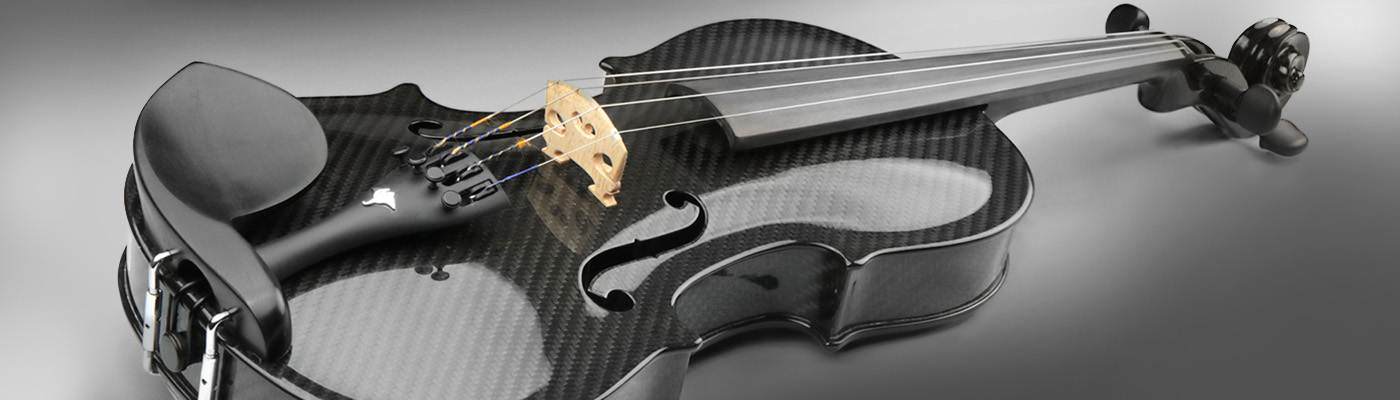
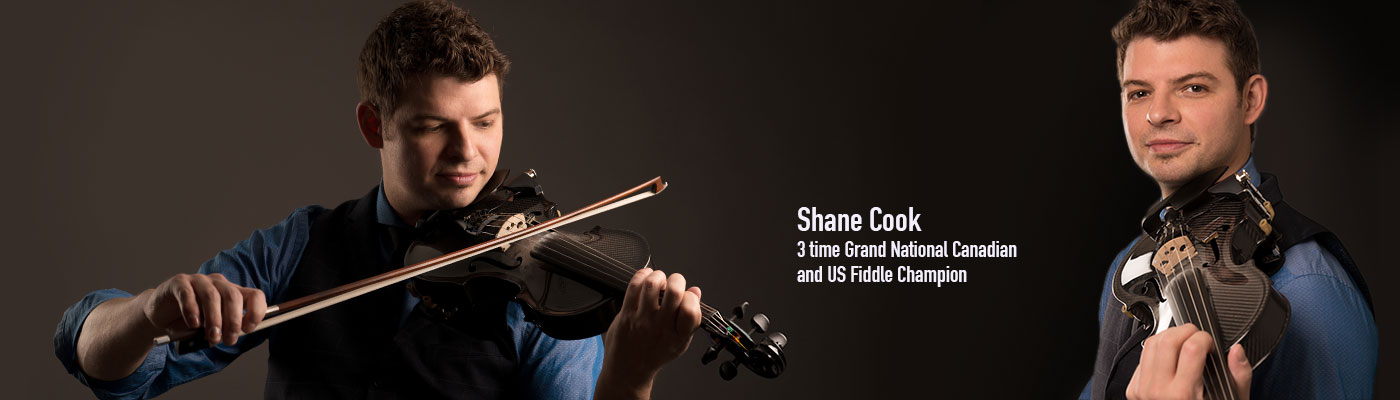
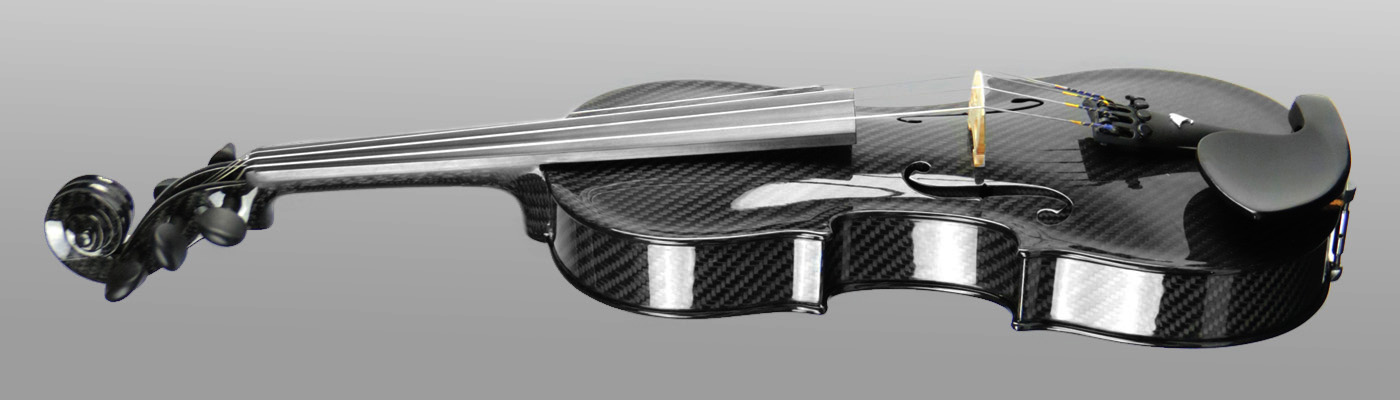

The first time you play our Carbon Fiber Violin you will immediately notice the tremendous power that it produces. Professional players tell us how balanced and easy they are to play. World travelers are no longer detained in airports having to show endangered wood credentials for their traditional violin. You can play in an igloo or arid desert without worry. We have even seen a carbon fiber violin being played under water. Carbon Fiber is light, strong and just plain beautiful.
We call our violin the Carbon Strad to honour the great Antonio Stradivarius who perfected the classic violin shape used by virtually every luthier today. Our carbon fiber violin is really a copy of the Stradivarius design, but instead of wood is made with a space age material called carbon fiber or graphite as it is sometimes referred to.
Humidity and temperature issues are a thing of the past, as this violin is not impacted by weather. It is all about the music now.
"Our goal from the beginning was to design and produce a world class sounding carbon fiber violin no matter the cost or time investment required. It must become an instrument of great beauty, following the classic lines of the master luthiers of the golden age of violin making. Using only the best of the best in materials and investing over four years of research and development, we believe we have finally achieved our goals."
Fred Gayford the driving force behind the Carbon Strad, has more than 36 years of experience working with all manner of composites materials and now specializing mainly in advanced carbon fiber composites.
Working with composite materials for more than 3 decades has taught Fred that nothing less than the absolute best will do. With the tolerance, flexibility and finesse that molded materials can offer, it truly comes down to the craftsman's ability to shape and imagine the possibilities in creating a product of beauty and refinement. That is why striving for perfection has always been Fred's driving force in every endeavour he takes on.
We were faced with many challenges in bringing the Carbon Strad to the marketplace. First we needed to faithfully duplicate the intricate and complex violin shape in carbon fiber. Secondly we needed to acoustically design the carbon fiber violin to produce a world class quality sound . This proved to be very difficult to achieve. After testing 30+ prototypes we finally had what we considered a good sounding instrument. We then had independent professional players evaluate the sound qualities and action of many prototypes. Listening carefully to their comments we continued to make corrections and improvements to the design.
There a number of methods of producing carbon Fiber parts.
This is the same techniques used by the aerospace industry and Formula One race car production. As far as we know, no other carbon fiber violin maker has gone to this method and it was hoped that we could with this advanced technique produce a really outstanding instrument and do our part in taking carbon fiber violins to the next level of sound quality.


There are 23 separate carbon fiber parts required to produce our violins. After producing the high temperature carbon fiber molds, we were ready to start making parts.
In this method pre-impregnated carbon fiber cloth is placed in the molds and vacuum bagged. The molds are then placed in the Autoclave pressure chamber and put under 60 PSI pressure. The internal heaters then ramps up the chamber to 175+ degrees, after a 12 hour period the heaters and pressure are slowly reduced and the cured parts are demolded. In essence the violin plates are subjected to a clamping pressure of around 8000 lbs at high temperature. Parts made this way have the highest fiber compaction possible with the least amount of excess resin.
We performed many experiments on dozens of violin plates using the three production methods described above. We conducted a tonal ring test on each of the violin plates and the results were very different from each method. Tapping the wet layup & infusion violin plates sounded like tapping on a drinking glass. Tapping on the Autoclaved violin plates sounded like tapping on a crystal glass. This expensive process yielded such incredible acoustical tonal qualities that we decided to use this method for all 23 parts of our violin.
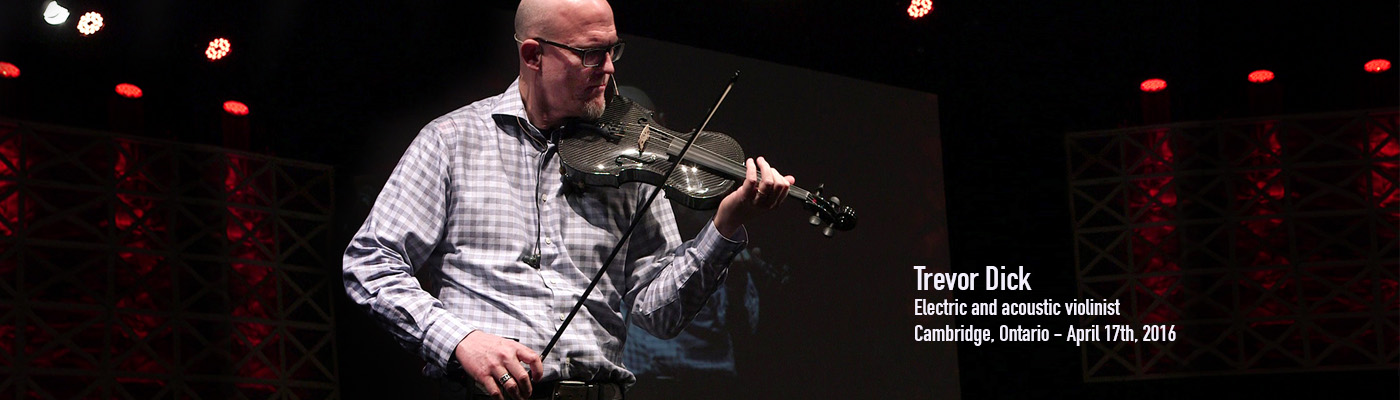
Testing the audio performance of the various finished pre-production violins at Fairmeadow Studio with master violinist Trevor Dick of “Flying Bow Music Ministries”
Exhaustive experiments were carried out on many violin plates to determine what the weave direction and layer thicknesses had on the overall tone qualities. Eventually we arrived at the best configuration for our violin tops and the back plates.
"Prepreg" is the common term for carbon fiber reinforcing fabric, which has been pre-impregnated with epoxy resin including the proper curing agent. The prepreg comes ready to lay into the mold. In order for the laminate to cure, it is necessary to use a combination of high pressure and the high heat of an Autoclave.
In a hand layup or vacuum infusion process, it is difficult to achieve a 50% resin content. Typical hand laminates and vacuum infusion, end up with a significant amount of excess resin. Excess resin increases brittleness and reduces the overall properties of the final product. On the other hand, most prepreg fabric contains around 35% resin. This is an ideal fiber to resin ratio. The final result is the strongest, lightest and consistent carbon fiber part possible.

Our violins are comprised of 23 individual, autoclaved, carbon fiber parts. They are then assembled by hand in precision, mounting fixtures. Dozens of hours of hand work go into the assembly, finishing and assembly of each instrument. Any part of our violins can be replaced if damaged, similar to repairing the parts on a wooden violin. Even though the parts are molded, there is a tremendous amount of hand craftsmanship involved to finish one of these beauties. General maintenance and setup can be performed by any Luthier. Sound post, bridge, strings, pegs etc.

Our Finger boards are made with AeroSpace uni-directional pre- impregnated carbon fiber in such a way that they look and feel exactly like an Ebony finger board. Most players have not noticed a difference in feel or look to the carbon fiber finger boards, they have to be informed that there is a difference. These Carbon finger boards are much lighter than Ebony and much stronger. The “Nut” is also made of carbon fiber plate, which should never wear down as is the case with ebony nuts.
The Carbon will not wear down like wood so they should never need a resurfacing treatment.
-
As woods like Ebony are becoming an endangered species there will not be the border crossing hassle with the Carbon Fiber Violin.

Hi tech composite material.
-
Enclosed gears with 8.5:1 turning ratio for very accurate tuning.
-
Germany engineering quality.

High tech composite for lightness and strength
-
Precision brass adjusters in metal bushings for long life and accurate tuning.
-
Included nylon tailgut with easy fit brass nuts.
-
German quality engineering.

The most difficult aspect of copying the Strad violin was duplicating the scroll in Carbon Fiber. A proprietary method we have developed has allowed us to duplicate the scroll and still maintain a light weight by giving the scroll a hollow interior.
To simply not have a scroll because of the manufacturing complexity was unthinkable. We feel the developmental headaches were well worth the effort and cost to produce such a beautiful Classical Violin shape.

Premium quality materials combined with skilled workmanship produces strings known for excellent pitch stability and longevity.
Heavy tension strings will allow for greater projection and volume potential. The E string is a plain steel E (tin-plated high-carbon steel) with no winding.

The number one choice of professional Violin players the World over.